
The Writing Style Check is one of the most popular and comprehensive reports that ProWritingAid offers. It highlights several areas of writing that should be revised to improve readability, including:
1) Passive Voice
This is one of those rules passed down by generations of writers: sentences written in the active voice tend to be more engaging for the reader. In an active sentence, the subject is at the start of the sentence and the object is at the end. For example:
- Jane watched the video. (subject - verb - object)
In the passive sentence, the subject is relegated to the end of the sentence:
- The video was watched by Jane. (object - verb - subject)
Like many of these rules, this does not mean that you must remove every occurrence – sometimes it works – but more often than not, you should rearrange your passive sentence to make it active, and therefore more effective. Consider:
- The doorbell was rung by the mailman to deliver the package.
- The mailman rang the doorbell to deliver the package.
The first sentence is written in passive voice, which means the person or thing doing the action (the mailman) follows the action (ringing the doorbell). Using the active voice turns the sentence around and puts the subject first. This makes the meaning clearer and the sentence shorter.
Sometimes in the passive voice the subject is completely omitted:
- The ball was thrown over the fence.
- Action was taken against the three trespassers.
- Katy was kissed at prom.
By whom? For the sake of clarity, it is usually better to tie your action to the person or thing that is doing the action. Otherwise your reader is left having to draw their own conclusions.
2) Adverbs
Adverbs are words that add color or emphasis to a verb. Compare these sentences:
- The barista made a cup of coffee.
- The barista grumpily made a cup of coffee.
The adverb “grumpily” offers an additional layer of understanding to the scene.
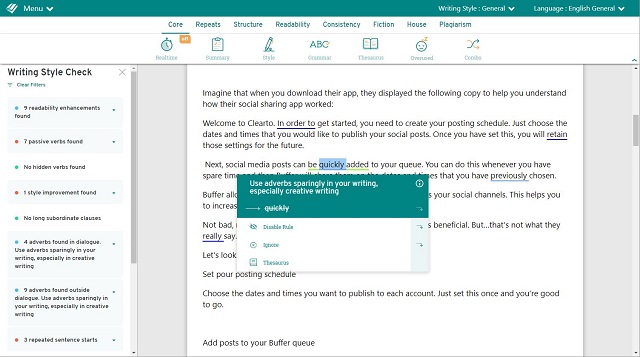
But, as Stephen King famously said, “The road to hell is paved with adverbs.” Lazy writers tend to use adverbs to modify a weak verb instead of searching for a stronger verb. Look at these examples:
We certainly don’t suggest that you remove ALL adverbs; sometimes they will be exactly right for what you are trying to get across. But adverbs tend to prop up weak verbs and so you should always ask yourself “Is there a stronger verb I can use here instead?”
3) Hidden Verbs
Verbs are the engine of our writing. They excite, engage and thrust it forward. Many novice writers end up accidentally hiding their verbs. This process (called nominalization) turns verbs into nouns and adds a weak verb in their place. For example:
- We will make an announcement of the winner on Friday.
- We will announce the winner on Friday.
The first sentence uses a weak verb (make) and hides a strong verb (announce) as a noun (announcement). The second sentence is shorter, clearer and stronger.
Hidden verbs are particularly common in business writing when writers are trying to use an “official” voice:
- analyzed ➡ undertook an analysis
- discussed ➡ held a discussion
- decided ➡ made a decision
- reviewed ➡ carried out a review
- explained ➡ gave an explanation
Highlight all your hidden verbs and reveal those strong verbs in all their glory.
4) Readability Enhancements
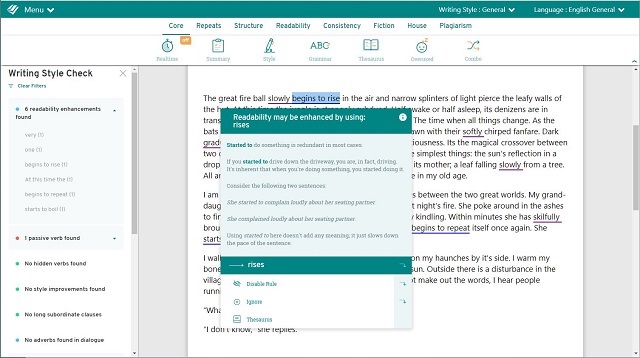
Our ProWritingAid copy editors have added thousands of individual style suggestions to the software.
Some are related to overused words like "very", "incredibly", "quite", "really" and "extremely," which should almost always be deleted as they rarely add anything to a sentence.
Others are related to clunky word order or phrasing. For example:
- is certainly going to ➡ will certainly
- didn't know anybody➡ knew nobody
- all of a sudden ➡ suddenly
- was going to ➡ would
- didn't have any ➡ had none
Again, these suggestions may not all make sense in your specific sentence. They are based on common changes that our copy editors regularly find themselves making. Use your judgement and follow the suggestions when you think it improves your paragraph.
5) Repeated Sentence Starts
The Style Check will highlight paragraphs where you have started multiple sentences with the same word. This is most common with pronouns: "I woke...", "I showered...", "I called...", etc.
Change up your sentence starts for more engaging writing.

Be confident about grammar
Check every email, essay, or story for grammar mistakes. Fix them before you press send.
